Church’s “The Heart of the Andes” shows a landscape containing numerous types of terrains. The foreground has a luscious forest along with a small glimmering pool below a waterfall. As the view expands the scenery gets less green and more barren and mountainous. The mountains are a mixture of orange-red with a tinge of purple near the peaks caused by the purple hue of the sky. Delving even further into the painting, a snowy mountain is seen in the distance. The peak contrasts greatly with the dry barren looking mountains which appear to not be too far away. The clear blue sky above the arctic scenery provides a brighter picture while there is a dark shadow looming over the bare mountains. There are minor details missed after initial inspection. The painting shows two people tending to a grave near a worn path and before the mountainous landscape there is a small settlement near a lake and forest.

“The Heart of the Andes” by Frederic Edwin Church (Source: http://camio.oclc.org)
Edward Hirsch’s “Edward Hopper and the House by the Railroad” is written in such a way that it characterizes the house, the painting in general, and the painter. Hirsch describes the house as someone who is being stared at, silently being judged. He imagines that the painter looking upon the house must think that there must be something wrong with it, that it must have done something to its inhabitants. It goes on to say that the house also did something to its surrounding environment because the sky is bland and there are no signs of any kind of life. The house then puts on an expression of its own. It expresses feelings of restlessness and nervousness. Soon the painter disappears and goes off to paint other abandoned buildings of a bygone era. Those very buildings will be judged and stared at the very same way. They will be looked at as someone who is going to be left alone once again.
“Edward Hopper and the House by the Railroad” depicts a house that represents American society before the Industrial Revolution. The house is a monument of 19th century architecture and therefore outdated in the face of the growth of urban life. As the poem shows, the house has been abandoned and is alone among the barren environment where only one set of railroad tracks run through it. The only purpose it has left is to be painted or written about in order to be regarded as history and become a mere memory. Such is the fate of a house that has long since been seen as inferior to more modern architecture. Edward Hirsch describes how lonely an existence that the house by the railroad has and perhaps even touches upon the lonely life of the artist. Through his poem he describes the true meaning behind Edward Hopper’s artistic piece. That meaning is the progression of American society and what society gains and loses. It gains more efficient and sleek buildings but in turn those buildings lose the ability to show emotion and creativity. The house by the railroad is able to be described in such a way that it’s given a personality and can project emotion. This would be difficult to do something similar for a generic looking skyscraper. “Edward Hopper and the House by the Railroad” by Edward Hirsch displays the haunting tragic beauty of Victorian architecture in Industrial America.
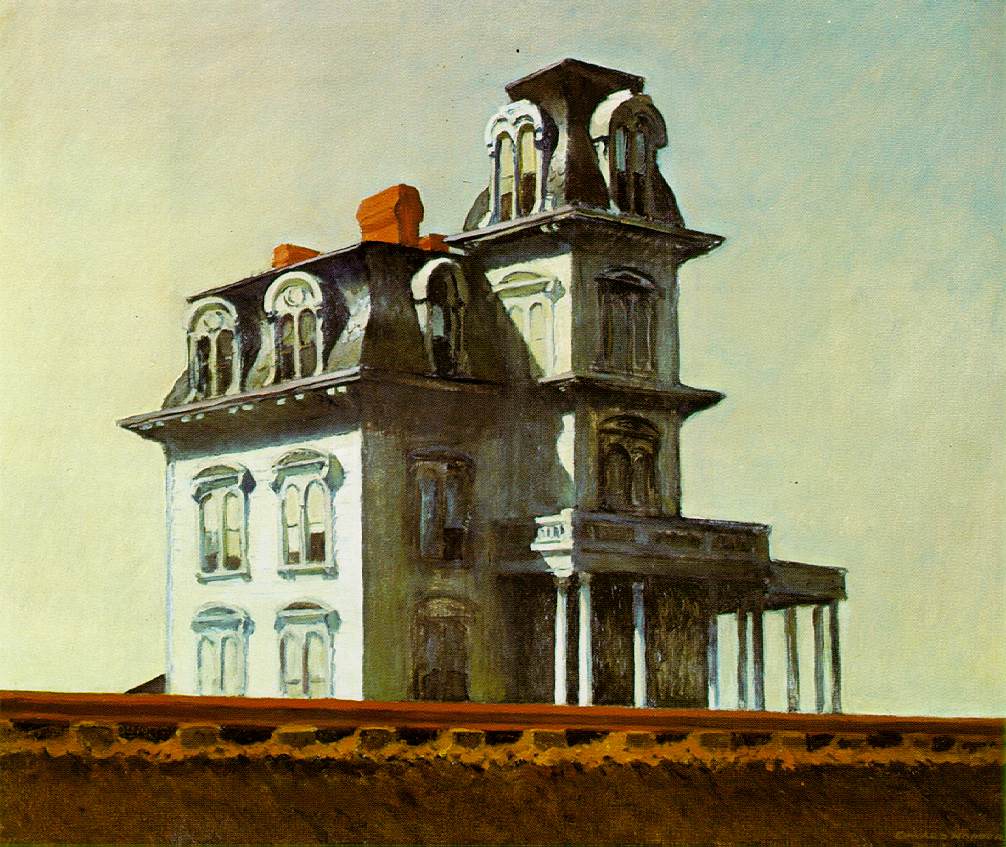
Edward Hopper and the House by the Railroad by Edward Hopper
(Source: http://www.ibiblio.org)
Frederic Edwin Church’s, “The Heart of the Andes” portrays the ideal scenery of the Andes in South America. This landscape portrait is displayed in such a way that it’s as if such a sight would be in one’s imagination. When the painting was initially shown to the public, a pamphlet was passed out containing praises and descriptions by Reverend Louis Legrand Noble. “Frederic Church” by John K. Howat contains an excerpt of it stating that, “by these rules is this great picture planned and painted. It has all those vital connections, blendings, gradations, repetitions and balancing requisite for perfect harmony and just proportion,” (83). The overwhelming sights of the mountains coupled with the dark hue the clouds hovering over them create contrasts greatly with the bright luscious scenery in the foreground. The portrait captures the essence, more specifically, the emotions that such a sight invokes. The emotions come in a sort of progression. At the foreground it begins with the tranquil scenery of the waterfall and lush nature.
This coupled with the small detail of the pair tending to a grave adding a hint of solemnity; the emotions at the time are feelings of tranquility and peace. However as the landscape pans out, the sight of the dark barren mountains brings about feelings of uneasiness because there’s little to admire. The top left side of the landscape has a bright snowy peak and it seems like the mountain itself cleared away the clouds and let the calm blue sky show. This mountain in particular shows colors of both white and a slight mix of light purple caused by the lingering dark clouds above it. This view stands out from the rest of the painting and it brings feelings of relief and calm. There is more to Church’s paintings than a “pretty face”. Church had goals for his paintings and “his goal was always the same; to make landscape painting rise above the merely descriptive and for far more than simply record the basic facts of the external world,” (Kelly 32). His ability to meld themes and ideals into his paintings is influenced by his mentor Thomas Cole. One object in particular that Church uses is the stump in his work of art, “The Memory of Cole” and “the stump was…a device Cole often used to suggest man’s destruction of the wilderness,” (Kelly 46). Church uses it to represent the end of a traveler’s journey, Thomas Cole’s spiritual journey of life. The religious undertones are shown by the small cross at the center of the foreground of the painting.

“To the memory of Cole” by Frederic Edwin Church (Source: http://www.theathenaem.org)
Edward Hirsch’s poems have a certain format noted in Peter Stitt’s critique of Edward Hirsch’s poem anthology “Wild Gratitude”. Stitt’s states that, “Written in a narrative style, the poems in Wild Gratitude display both unsentimental personal reflections…and elegiac tributes to artists and writers of the past,” (194). Edward Hopper and the House by the Railroad is just that, a tribute by Hirsch that displays the possible inner thoughts of Edward Hopper. Hirsch doesn’t write these poems to just give his two cents on what the painting means but to also give his respects to the artist’s brilliance. As an artist, Hirsch has his own personal reflections and one in particular is titled, “A Dark Hillside”. Hirsch muses that, “the afternoon’s deep shadows, the silence of the country at dusk can still seem like a kind of promise, a pact between the red elms and dusky clouds,” (Hirsch 73). Hirsch further displays his talent of showing things to have a mind of their own and that certain elements “communicate” with each other unbeknownst to people. Hirsch shows that he can not only have a house display emotion through his poems but he can describe the haunting beauty of Nature and characterize its elements as well.
Both Hirsch and Church’s ability to invoke subtle emotions and thought into the minds of their viewers is remarkable in their own right. Hirsch accomplishes this through a narrative style when writing his poems. So it’s either through his eyes or the eyes of the artist that he is paying homage to. While Church does this by touring the places that he paints and implementing his own creative touches to the scenery, making the nature look divine. However, it’s been stated that it’s not just ideal scenery that Church paints. Church creates these landscape paintings with faint themes and messages.
Hirsch’s and Church’s primary works of art express a high level of emotion. Hirsch is able to give a house the ability to express itself while Church shows the sheer variety of emotions a landscape can possess. Hirsh’s poem brings about feelings of pity and solitude and Church’s portrait inspires awe with its divine looking scenery. What they focus on may contrast, with Hirsch focusing on the progress of manmade structures and Church on the pure beauty that Nature creates. However, both artists delve deeper into what they initially see and bring forth a whole new meaning to the view.
Annotated Bibliography
Carr, L. Gerald and Franklin Kelly. The Early Landscapes of Frederic Edwin Church 1845-1854. Fort
Worth, Texas: Amon Carter Museum 1987.
This is a book that gives information on how Frederic Edwin Church came to prominence as a landscape artist during the first decade of his career. Specifically how Church didn’t start out painting luscious landscapes of foreign countries and even when he got to that point, his work wasn’t widely positively received. There are facts on Church’s mentor, Thomas Cole and how his style of painting landscapes and implementing symbolism transferred to Church. He then made the style his own and toured many sights of Nature and painted them as if they were created through imagination alone. Such a style wasn’t well received but gradually grew on the American public and they were soon in awe of his work. The book provides useful information on the early life of Frederic Edwin Church and how he became the artist that he was. This is an essential source for those who are doing research on the artistic career of Church and need to find the source of his talent.
Church, Frederic Edwin. The Heart of the Andes. Camio: A catalog of Art Museum Images
Online. 1859. Web. 5 Nov. 2010
This site houses many a work of art which ranges from photographs to sculptures. Camio hosts hundreds of pictures of many pieces of art and provides basic info such as its creator, when it was created, and the museum it’s being displayed at. The site would be useful for finding pieces of art and wanting to see them in person because it also lists museums and galleries and the works they house. This site is useful for finding credible images of artwork and can be used freely for educational and research purposes as long as credit is given.
Church, Frederic Edwin. To the Memory of Cole. Private Collection. 1848. Web. 2 Dec. 2010
A site named The Athenaeum that provided this image has practically the entire works of Frederic Edwin Church reproduced and on display electronically along with many other collections of artwork, poems. This includes a record of all artists that contributed their work to the site and a database of how many pieces they have on the site. Anyone can register on the site and contribute different pieces of writing and art. As well as be updated on the latest news concerning the Arts and Humanities. If one wished to obtain reproductions of famous works of art for a project on a certain artist, then this site would be one of the first ones to check into.
Hirsch, Edward. Wild Gratitude. New York: Knopf, 1986.
This source is a collection of Edward Hirsch’s poems that are mostly themed towards loneliness. Wild Gratitude contains a combination of analysis and tribute to artists and their works along with the solemn self reflections of Hirsch himself. It’s useful for obtaining and analyzing the many works by Edward Hirsch. However it can also be used to better understand the artistic pieces it’s describing which is the case of Edward Hopper and the House is by the Railroad.
Hopper, Edward. “House by the Railroad”. http://www.ibiblio.org. 2002. Web. 2 Dec. 2010
Image of Edward Hopper’s “House by the Railroad” was obtained by a public library and digital archive. The site hosts many categories of subjects such as history, biographies, geography, and social sciences. The user enters the subject into the search engine and is provided with links to other credible sites where facts that are sought after may be found. This site would be useful for many research projects given its wide range of provided information.
Howat, John K. Frederic Church. Yale University Press, 2005.
The book provides a chronological timeline of Frederic Edwin Church’s major works throughout American history. Along with the images of the landscape paintings, there is detailed background information and history on the piece of art and how it came to be. This includes the praise and criticism that Church received for his earlier works such as “The Heart of the Andes”. Such information would be particularly useful when trying to find facts on Church’s works of art and how he came into prominence in the artistic field.
"Wild Gratitude by Edward (Mark) Hirsch." Contemporary Literary Criticism. Ed. Sharon K.
Hall. Vol. 50. Detroit: Gale Research, 1988. 194-199. Literature Criticism Online. Gale.
UMass Dartmouth. 5 November 2010. Database
This article provides an extensive review on Edward Hirsch’s poem compilation,“Wild Gratitude”. It also provides a bit of background on Edward Hirsch and the process that he goes through when trying to find inspiration or how inspiration comes to him. It breaks down the poems of the compilation into two categories, homage’s to artists and bleak narrative vignettes. The review is useful for trying to understand what message certain poems are trying to relay to the reader because it names a few poems that fall under one of the two categories. A review that helps better understand the mind of Edward Hirsch and the general themes he shows in his poems.

This is great. I enjoyed it in its first draft. And I like it better in the final form. Your visuals add appeal and understanding, which is not as easy to do as it seems. Your prose style is clear and convicing. Youguide the redaer through all stages of the task. And you use research to support your own thoughts and feelings. GRADE 97/100
ReplyDelete